Non-penetrating World Models
World Models Not valid through walls
Teaching world models to say NoPe to obstacles.
of generated videos penetrate or erase the obstacle. Averaged over six frozen world models on NoPeBench, before and after NoPeWorld. Task 2 violation rate (the camera penetrates, tunnels through or erases the obstacle; VGGT-Ω evaluator on true Unreal geometry), averaged over six world models: raw model vs. NoPeWorld in collision mode. Bars: one per world model.
AbstractRead
We study a new problem of preventing object penetration in interactive video world models. To understand how existing models handle this, we introduce NoPeBench, a benchmark that evaluates how world models respond to physical obstacles. Our evaluation reveals that none of the open-source models can reliably prevent such failures.
Surprisingly, however, these models already encode the information needed to predict such violations. We find that the hidden states of diffusion transformers (DiTs) can predict whether a candidate action will penetrate an obstacle. Building on this, we introduce NoPeWorld, a lightweight framework that detects and prevents penetration. Specifically, we train a small prediction head on top of a frozen DiT's hidden states to read out if a candidate action is safe or not. Unsafe actions are then replaced with safe ones that best preserve the original intent.
Despite its simplicity, NoPeWorld substantially reduces the physical violation rate, averaged over six video world models, from 74% to 16%. Remarkably, our method shows zero-shot generalization to open-domain imagery, third-person viewpoints, and moving obstacles. We publicly release our code, the NoPeBench benchmark, and model weights at the links above.
World models pass through obstacles.
With W+A held into a courtyard wall, five of six world models pass through it and one backs away. Unreal Engine slides along it.
Stop or slide. Never pass through.
Red follows your keys, as a raw world model does. Black keeps only the motion the obstacle allows, as a game engine does: it stops head-on and slides when oblique.
Collide-and-slide (Baraff, 1989): u the commanded motion, n the wall's normal. Rays: the 34 candidate motions for the next chunk (0.9 m), green when the swept collision disc keeps a 5 cm margin on this map. Thick: the training label, the safe candidate closest to the collide-and-slide response. NoPeWorld has no map: its head learns these labels from Unreal replays and then reads them off the video model's hidden states.
The DiT already predicts the contact.
Before a chunk is drawn, the frozen DiT's hidden states already tell which candidate motions would penetrate the obstacle.
One chunk ahead, before those frames are denoised.
On VAE latents or decoded pixels, the same head barely beats keeping the input.
The raw model still passes through. NoPeWorld turns the prediction into the action.
Read the DiT, replace unsafe actions.
Before each chunk, a head with under 2M parameters reads the frozen DiT and scores 34 candidate motions. A safe input is kept; an unsafe one is replaced by the closest safe motion.
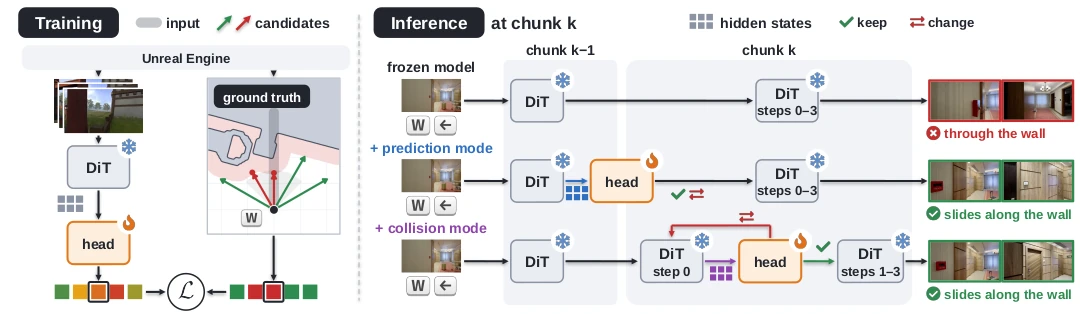
- 1Read. A head with under 2M parameters reads the frozen DiT before the chunk is drawn.
- 2Score. It rates 34 candidate motions for safety and intent.
- 3Act. Safe: keep the input. Unsafe: take the closest safe motion.
Reads step 0 of chunk k; reruns only step 0 when it changes the input.
Reads the states of chunk k−1: no extra DiT pass.
The baseline: decodes every chunk and runs a depth network (DA3) on it.
NoPeBench: does it stop at the wall?
100 routes into solid obstacles, 50 open paths where stopping would be wrong, and 131 open-domain images, in three tasks.
Evaluates whether the model corrects unsafe actions while preserving safe ones.
Evaluates whether generated videos avoid obstacles while preserving intended motion.
Evaluates whether the model avoids static and moving obstacles in unseen scenes.
Every route, every verdict
All 150 Task 2 routes with the evaluator's verdict for every world model and method. All 150 Task 2 routes, unfiltered: the evaluator's verdict for every world model and method (VGGT-Ω, rule v3.1), the true map and every reconstructed camera path. Task 1 runs on the same 100 collision routes, teacher-forced on Unreal's history, in 32 held-out scenes. Clips here are small previews (raw and collision mode; open paths: collision mode). A path whose history part misses the true history by more than 15 cm is not drawn, as in the paper's figures (226 of 3,400).
Click a route to play its videos.
Fewer violations, more intent kept.
The best Safe-Intent Score and Overall on all five pose-driven world models. External depth, which can only stop, violates less on four of them but cannot slide.
Task 1: the decision on the true history
Share of decisions, 100 routes. The raw model misses every unsafe input and changes no safe one.
Open paths: does it stop for nothing?
Share of the 50 open-path videos that neither stop early nor go back.
NoPeWorld responds like the engine.
Task 2 routes: Unreal, the raw model, external depth and NoPeWorld on one route and one clock. Scrub, step with ← →, slow it down.
Wipe: raw vs. NoPeWorld, head-on
Only on head-on routes with a straight input, where both cameras start on the same line.
It transfers without retraining.
Trained only on first-person walks through static Unreal scenes, the heads cut violations on open-domain images, in third person and around moving obstacles.
BibTeX